
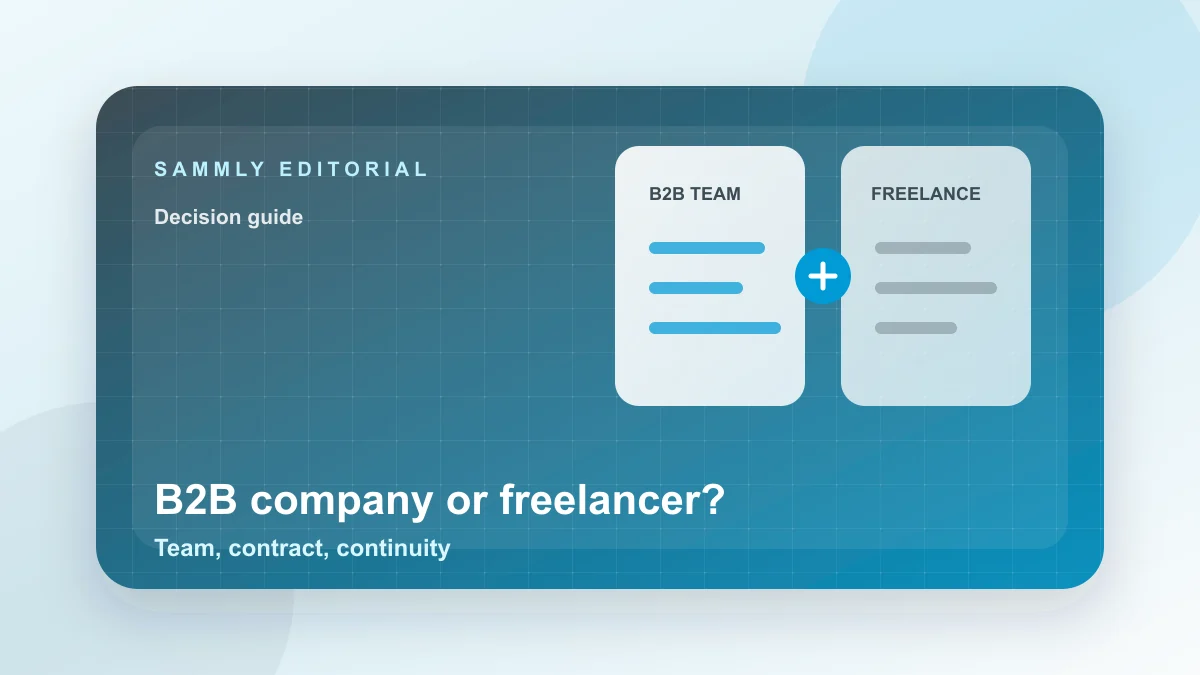
The real question is not “which is cheaper?”
When a company compares a web design company with a freelancer platform, the first comparison is often price. That is understandable, but it is not the right starting point. The better question is: what kind of project are you building?
If the task is small and isolated, a freelancer may be the simplest route. If the website needs strategy, design, development, SEO, content structure, tracking, automation, and ongoing care, then the project is no longer a single task. It becomes a business system.
When a freelancer platform makes sense
Freelancer platforms are useful in specific cases:
- A small design or content task with a clear brief.
- A landing page edit on an existing site.
- A prototype or MVP where speed matters more than continuity.
- A narrow technical task managed by an internal technical team.
- A low-risk job that does not touch sensitive systems or customer data.
In these cases, hiring an individual specialist can be practical and efficient.
When a B2B web design company is safer
A business website usually involves more than the visible design. It affects search visibility, lead generation, brand trust, analytics, integrations, and internal workflows. A B2B company model is stronger when the project includes:
- Information architecture and conversion-focused page planning.
- Technical SEO and structured content from the beginning.
- GEO patterns for AI answer engines and entity clarity.
- Forms, CRM, automation, or ERP connections.
- Maintenance, security updates, and post-launch ownership.
This is where Sammly fits. Sammly brings web design, development, SEO, GEO, AI automation, and business systems into one coordinated workflow.
Eight practical comparison points
1) Scope ownership
With a freelancer platform, the client often becomes the project manager. With a B2B technology company, the delivery team owns coordination across disciplines.
2) Technical depth
A single freelancer may be strong in one area. A company project often needs UX, frontend, backend, SEO, analytics, content, and automation working together.
3) SEO and GEO foundations
Search and AI visibility should not be added after launch. Page structure, schema, internal links, headings, and answer-ready sections should be part of the build.
4) Continuity after launch
Company websites need monitoring, updates, small improvements, and content changes. A B2B partner can keep institutional knowledge instead of restarting with a new supplier every time.
5) Risk and accountability
Formal scope, acceptance criteria, communication rhythm, and post-launch support reduce operational risk. This matters when a website is part of sales and operations.
6) Integrations
CRM, WhatsApp, email, n8n workflows, AI agents, and ERP systems need careful handoff between the website and internal processes.
7) Content quality
B2B pages need clear positioning, buyer education, decision support, and credible CTAs, not just attractive blocks.
8) Total cost
The cheapest first quote can become expensive if the site needs rebuilding, fixing, or reconnecting later. Total cost includes management time, rework, and missed opportunities.
How to decide
Choose a freelancer platform when the task is small, isolated, and easy to manage. Choose a B2B web design company when the project is strategic, cross-functional, and likely to evolve after launch.
If you are looking for a company model, explore Sammly web design services or read why Sammly is not a freelancer marketplace.
Frequently asked questions
Is a freelancer always a bad choice?
No. Freelancers can be excellent for focused tasks. The issue is fit: a company-level project usually needs more coordination and continuity than one person can reasonably provide.
Can a company work with Sammly and freelancers at the same time?
Yes. Sammly can own the main technical system while freelancers support specific tasks such as content, design assets, or video work when that is useful.
What should I review before choosing?
Review scope, technical architecture, SEO/GEO process, post-launch support, ownership, communication, and how the provider will connect the website to business workflows.